Stephen Hawking
Biography
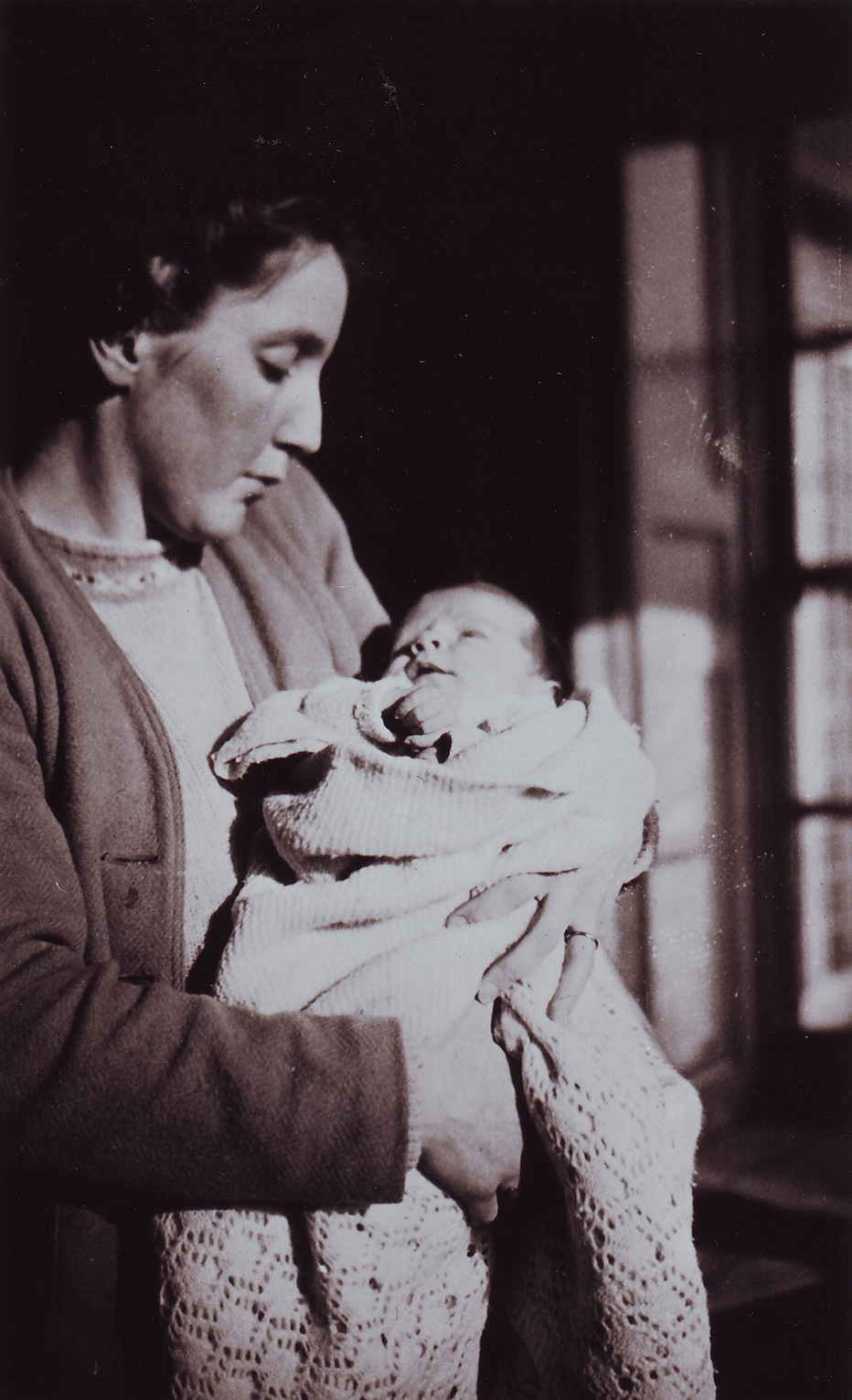
It is a curious fact that Stephen William Hawking was born on 8th January 1942, exactly 300 years after the death of the Italian astronomer, Galileo Galilei. Perhaps it seems a fitting symmetry. Often referred to as ‘the father of observational astronomy,’ Galileo was one of Stephen’s inspirations during his long career as a theoretical physicist and cosmologist.
Stephen was born in Oxford during WWII, the eldest of four children to parents Dr Frank Hawking and Eileen Isobel Hawking. With his siblings, Stephen had a happy childhood mostly spent in Highgate, London and then in St. Albans, Hertfordshire. Stephen admitted to being a late developer and recalled that he was never more than halfway up the class at St Albans School. However, he developed an early curiosity as to how things work, saying later, ‘If you understand how the universe operates, you control it, in a way.’ His classmates called him ‘Einstein’ as they clearly saw the signs of genius in him, missed by his teachers. While still at school, Stephen speculated about the origin of the universe with his friends and wondered whether God created it – “I wanted to fathom the depths of the universe.” This spirit of enquiry set the pattern for his academic career.
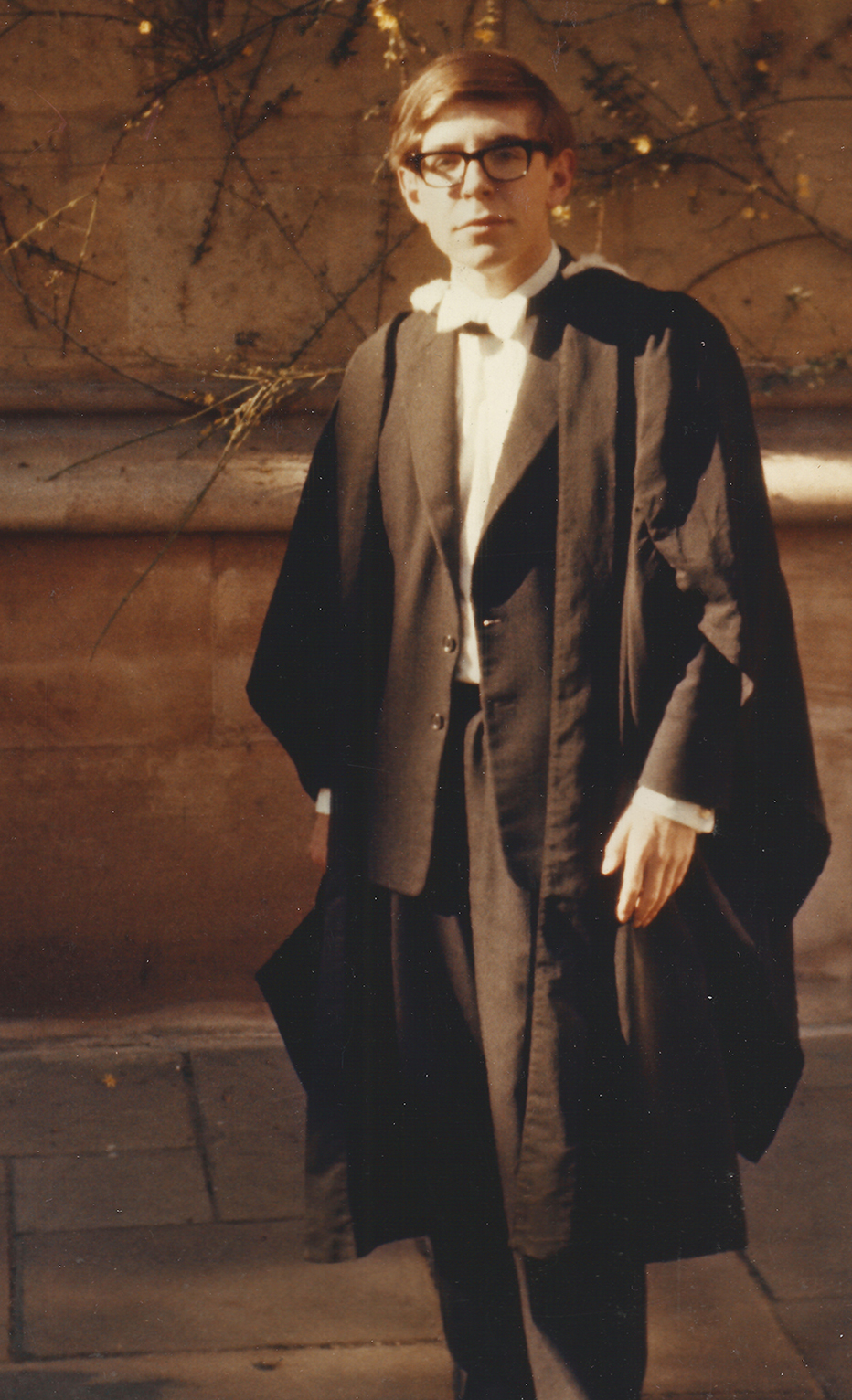
Somewhat reluctantly, Stephen agreed to apply to his father’s college, University College, Oxford. Stephen wanted to read mathematics but his father, tropical medicine specialist Dr Frank Hawking, was adamant that there would be no jobs for mathematicians and Stephen should read medicine. They compromised on Natural Sciences and Stephen went up to Oxford at the young age of 17 in 1959. Despite claiming to do very little work, Stephen performed well enough in his written examinations to be called for a ‘viva’ (an interview) to determine which class of degree he should receive. Stephen told the examiners that if they awarded him a first-class degree he would leave Oxford and go to Cambridge but if he got a second, he would stay in Oxford. They duly gave him a first, as of course, he hoped they would. Stephen went to Trinity Hall, Cambridge in 1962.
However, while still an undergraduate, Stephen had begun to realise all was not well. He had become increasingly clumsy, was struggling with small tasks such as doing up his shoelaces and his movements were erratic and ungainly. After an accident at a skating lake in St Albans, his mother took him to Guy’s Hospital in London for tests. Soon after Stephen’s 21st birthday, these tests showed he had a progressive and incurable illness. These tests were exhaustive although primitive by today’s standards. Even after these were completed, oddly Stephen was not told his diagnosis. Eventually, he discovered he had motor neurone disease which slowly and inexorably erodes muscle control but leaves the brain intact. He was given only two years to live. Stephen later recalled that he became desperately demoralised at this time but he did find two sources of inspiration and solace: the intense music of Wagner (a subsequent lifelong passion) and falling in love with Jane Wilde, the woman who would become his wife. The young couple vowed to fight Stephen’s illness together. Stephen now had someone to live for, and in the manner typical of his stubbornness, he threw himself into his research – “To my surprise I found I liked it”, he said later.
Despite his renewed enthusiasm, Stephen’s early career progressed erratically. In Cambridge, he had hoped to study under the most famous astronomer of the time, Fred Hoyle, but Professor Hoyle had too many students already and sent him to physicist and cosmologist Dennis Sciama instead. Later, Stephen recognised this as a piece of luck which laid the foundation of his later career and said that he would have been unlikely to flourish under Hoyle’s supervision. In fact, the two clashed in public in 1964 when Stephen interrupted Fred Hoyle, during a lecture, to tell the famous scientist he had got something wrong. When Hoyle asked how he knew this, Stephen said, ‘Because I have worked it out’. Sciama also introduced Stephen to Roger Penrose in 1965 when Penrose gave a talk on singularity theorems in Cambridge. In that same year, Stephen received his Ph.D for his thesis entitled ‘Properties of Expanding Universes.’ This thesis was released in 2017 on the University of Cambridge’s website, causing the site to crash almost immediately due to the extraordinarily high demand.
In 1965, Stephen applied for a research fellowship at Gonville & Caius College in Cambridge and was accepted. He was to remain a fellow there for the rest of his life. Marriage to Jane and children followed; Robert (1967), Lucy (1970) and Timothy (1979). Supported and cared for by his wife, his loyal PhD students, friends, family, colleagues and his children, Stephen settled into day to day academic life, and continued working right up until his death in March 2018.
The accolades began. In 1966 Stephen won the Adams Prize for his essay entitled, ‘Singularities and the Geometry of Space-Time’, and which formed the basis for his first academic book, co-authored with George Ellis, The Large Scale Structure of Space-Time. This book remains in print today.
In 1969, during a trip to the USA, Stephen observed Joseph Weber’s early and rudimentary experiments for detecting gravitational waves. Stephen would have loved to conduct his own experiments in this new and exciting scientific area but understood that his disability was a barrier in that era. As ever, Stephen made an advantage out of what other people would perceive as a setback, arguing that a theorist can conclude an argument in an afternoon: an experiment can take years. “I was glad I remained a theorist”, he admitted afterwards.
Against the background of increasing and fervent scientific discovery, Stephen began working on the basic laws that govern the universe – the field he had been obsessed with since he was a young schoolboy. Since their first meeting in 1965, Stephen and Roger Penrose had many discussions about singularity theorems which culminated in their joint paper in 1970. In that paper, Stephen showed that Einstein’s general theory of relativity implied space and time would have a beginning in the Big Bang and an end in black holes. Together, Hawking and Penrose developed a singularity theorem proving this theory and this led to Stephen’s ensuing fascination with black holes. His subsequent work in this area laid the foundations for today’s understanding of the universe and how it began.

The 1970s were a prolific period of work. In 1970, shortly after the birth of his daughter and in a ‘eureka’ moment, Stephen realized, almost in an instant:
● that when black holes merge, the surface area of the final black hole must exceed the sum of the areas of the initial black holes,
● that this places limits on the amount of energy that can be carried away by gravitational waves in such a merger,
● there are parallels to be drawn between the laws of thermodynamics and the behaviour of black holes.
In 1973, and at a bit of a loose end after the publication of his first book, The Large Scale Structure of Space-Time, Stephen decided the next step in his research would be to combine general relativity (the theory of the very large) with quantum theory (the theory of the very small). To his disbelief, it seemed that emissions could emanate from a black hole, that particles could escape, i.e. ‘radiate’ from a black hole’s event horizon, a revolutionary quantum effect that appeared to make a mockery of the laws of physics. This research was published in 1974 by Nature as ‘Black hole explosions?’. However, when announced at a conference in Oxford, his theory was seen as controversial and angrily disputed. Now widely accepted and known as Hawking radiation, Stephen’s proposal unifies the seemingly impossible – general relativity with quantum theory, the large with the small.
Despite their names becoming joined in a formula, Stephen and Jacob Bekenstein never actually worked together. In 1972, Bekenstein proposed that black holes have an entropy. Bekenstein had a formula for entropy that said the entropy was proportional to the area of the event horizon but his numerical co-efficient was incorrect. Stephen did not believe this because black holes were thought to have zero temperatures. It was not until Stephen discovered black hole temperature that he came to believe that black holes have entropy. Stephen was able thereby to confirm the idea that black holes have entropy and fix the coefficient in Bekenstein’s formula.
S = Entropy
A = The area of the horizon
c = The speed of light
G = Newton’s constant of gravitation
k = Boltzmann’s constant
ħ = Planck’s constant
Stephen’s equation reveals a ‘deep and previously unexpected relationship between gravity and thermodynamics, the science of heat’. But it also raises questions – where does the information about the previously existing matter go when matter ‘disappears’ into a hole? And if information is lost, this is incompatible with quantum mechanics at least in its usual form. This is Stephen’s black hole ‘Information Paradox’ that violates a fundamental tenet of quantum mechanics and has led to decades of furious debate.
The late 1970s were a golden age for Stephen’s academic career and for the field of theoretical physics in general. After being promoted to Reader in Gravitational Physics at Cambridge in 1975, and subsequently Professor of Gravitational Physics in 1977, in 1979 he was appointed as the Lucasian Professor of Mathematics, a position he held until 2009. The chair was founded in 1663 with money left in the will of the Reverend Henry Lucas who had been the Member of Parliament for the University. Previously held by Isaac Newton in 1669, this chair was awarded to Stephen in recognition of his ground-breaking scientific work on black holes. In 1979 Stephen was also awarded the first, prestigious Albert Einstein medal, in recognition of ‘scientific findings, works or publications related to Albert Einstein’. This was a period of intense speculation in physics and growing public interest in black holes. Journalists for print and television regularly interviewed Stephen - his name was becoming known.
Stephen sought to understand the whole universe in scientific terms. As he said famously, ‘My goal is simple. It is a complete understanding of the universe.’ The singularity theorems proved by Stephen and Penrose had shown conclusively that the universe had a beginning in a Big Bang. But the singularity theorems did not say how the universe had begun. Rather, they showed something more sweeping: Einstein’s general relativity breaks down at the Big Bang, and quantum theory becomes important. Working with Jim Hartle, Stephen set out to use the techniques he had developed to understand the quantum dynamics of black holes, to describe the quantum birth of the universe. Stephen first put forward a proposal along these lines at a conference in the Vatican in 1981, where he suggested that the universe began with four space dimensions curled up as a sphere, without any boundary, which through a quantum transition gave rise to the universe with three space dimensions and one time dimension that we have today. Asking what came before the Big Bang, he famously said, `is like asking what lies South of the South Pole’. Stephen and Hartle aptly called their model the no boundary wave function, or no boundary proposal, the first scientific model of the origin of the universe.
Stephen continued to study the no boundary proposal throughout his career. He discovered that there was a profound connection between the no boundary wave function and cosmic inflation – the idea that our universe started with a rapid burst of expansion. In a series of papers over many years Stephen and his students consolidated this connection, showing that the no boundary proposal predicts an early period of inflation. But the scientific importance of the no boundary proposal is not just as a successful theory of the origin of the basic structure of the universe. Perhaps even more important is the impact it has had on how we think about the universe, and our place in it. The no boundary proposal describes an ensemble of universes. Working with Thomas Hertog, Stephen showed this leads to what he called a `top-down approach to cosmology’, reconstructing the universe’s history backwards in time starting from our position within it. ‘The history of the universe depends on the question we ask,’ he used to say.
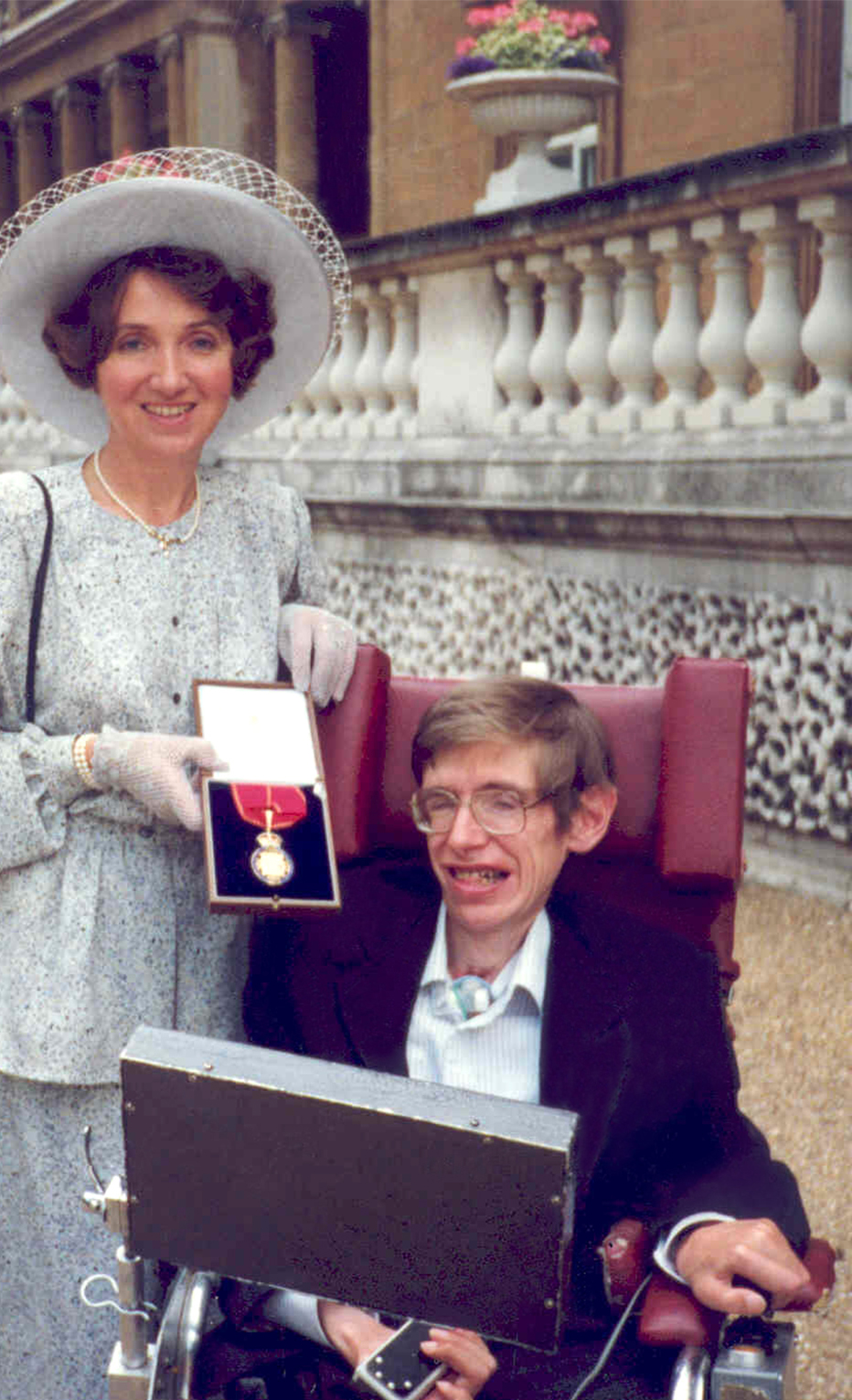
In 1982, a letter from Buckingham Palace arrived at Stephen’s family home in Cambridge to tell him he had been honoured with the award of a CBE - Commander of the British Empire. Stephen, despite his anti-establishment leanings, still felt proud to accept it as a mark of his outstanding achievement. The award also heralded the first of what would turn out to be many meetings with Her Majesty the Queen over the decades to come. But neither Stephen nor his family could have known that at the time, as the great scientist was constantly aware that each day could be his last.
Despite his condition, Stephen was an enthusiastic traveller, although his journeys did not always go smoothly. In 1985 Stephen contracted pneumonia on a trip to a science conference near Geneva. The Swiss doctors advised his wife, Jane, that recovery was impossible, and she should switch off Stephen’s ventilator which would have brought about his immediate death. Jane flatly refused and arranged for Stephen to be flown home to Addenbrooke’s Hospital in Cambridge. In order to save Stephen’s life, a tracheostomy was performed, which had the difficult side effect of taking away his natural speaking voice. After a frustrating period where he was only able to communicate with a spelling card and eyebrow movements, Stephen was relieved and delighted when technology came to his rescue. He worked closely with computer developers, latterly at Intel, to devise a computerised communication system and voice synthesiser that, with its famously flat American accent, quickly became his trademark. Stephen learned the art of brevity, of expressing complicated ideas and opinions in very few words. Using this system, Stephen not only wrote seven books and a number of scientific papers but developed his own style of dry, unanswerable wit. It was during this challenging period that Stephen began working on A Brief History of Time, an idea he first had in 1982.
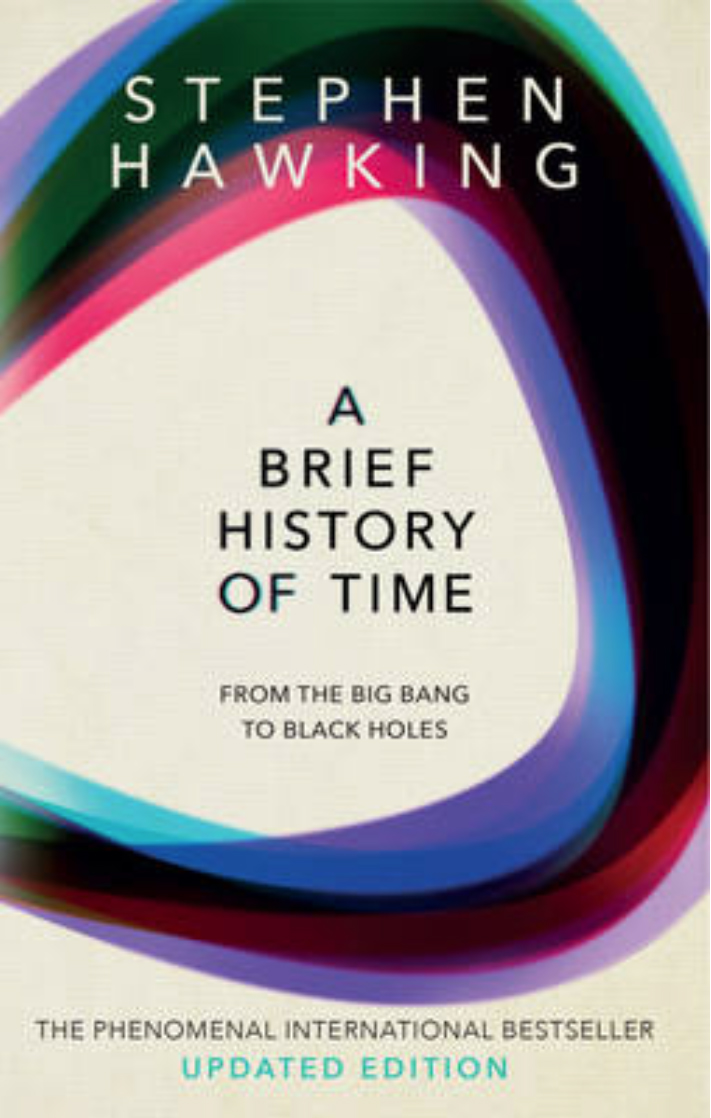
Determined to write a book about physics that would sell at airport book shops, sharing the excitement of science with a general audience, Stephen toiled over A Brief History of Time for six years. His hard work paid off as this book became a surprise runaway best seller which also propelled him into an ever-widening public sphere with, at times, intense media speculation. A Newsweek cover at the time described him as a ‘Master of the Universe’. Helpfully, A Brief History of Time turns complicated scientific theories and projections into (mostly) everyday language: as Stephen said, “I think it is important for scientists to explain their work, particularly in cosmology”. Its resounding success led to a spot on the UK best-selling list for a record-breaking 4.5 years, translation into over 40 languages and sales of over 20 million copies. It was said that Stephen had answered the most fundamental questions of existence. Stephen had always firmly believed that everyone should have a basic understanding of science in this increasingly scientific and technological world and dedicated an enormous amount of time and effort in order to engage the general public with science. He has also co-authored a series of six adventure novels about science with his daughter, Lucy Hawking, in order to make science entertaining and accessible to a young readership.
The 1990s were another period of relentless work academically and now, increasingly, as a popular author and celebrity. In 1993 he published Black Holes and Baby Universes and Other Essays, a collection of works exploring ways in which the universe may be governed. This was followed in 1998 by Universe: The Cosmos Explained, clarifying the basis of our existence with more following in the 2000s – Universe in a Nutshell (2001), On the Shoulders of giants (2002) and The Theory of Everything: The Origin and Fate of the Universe (2002). While these did not achieve the global accolade of A Brief History of Time, they all successfully contributed to our general body of scientific knowledge.
Academically, Stephen continued his work in physics and in 1993 co-edited a book on Euclidean quantum gravity with Gary Gibbons. In 1994 Stephen and Roger Penrose delivered a series of six lectures that were subsequently published in 1996 as The Nature of Space and Time, and Stephen enjoyed several of his now-famous scientific ‘bets’ he had with colleagues, notably with Kip Thorne and John Preskill at Caltech, and Peter Higgs over the existence of the Higgs Boson (Stephen lost that one). Stephen also married again in 1995 to Elaine Mason, a former nurse.
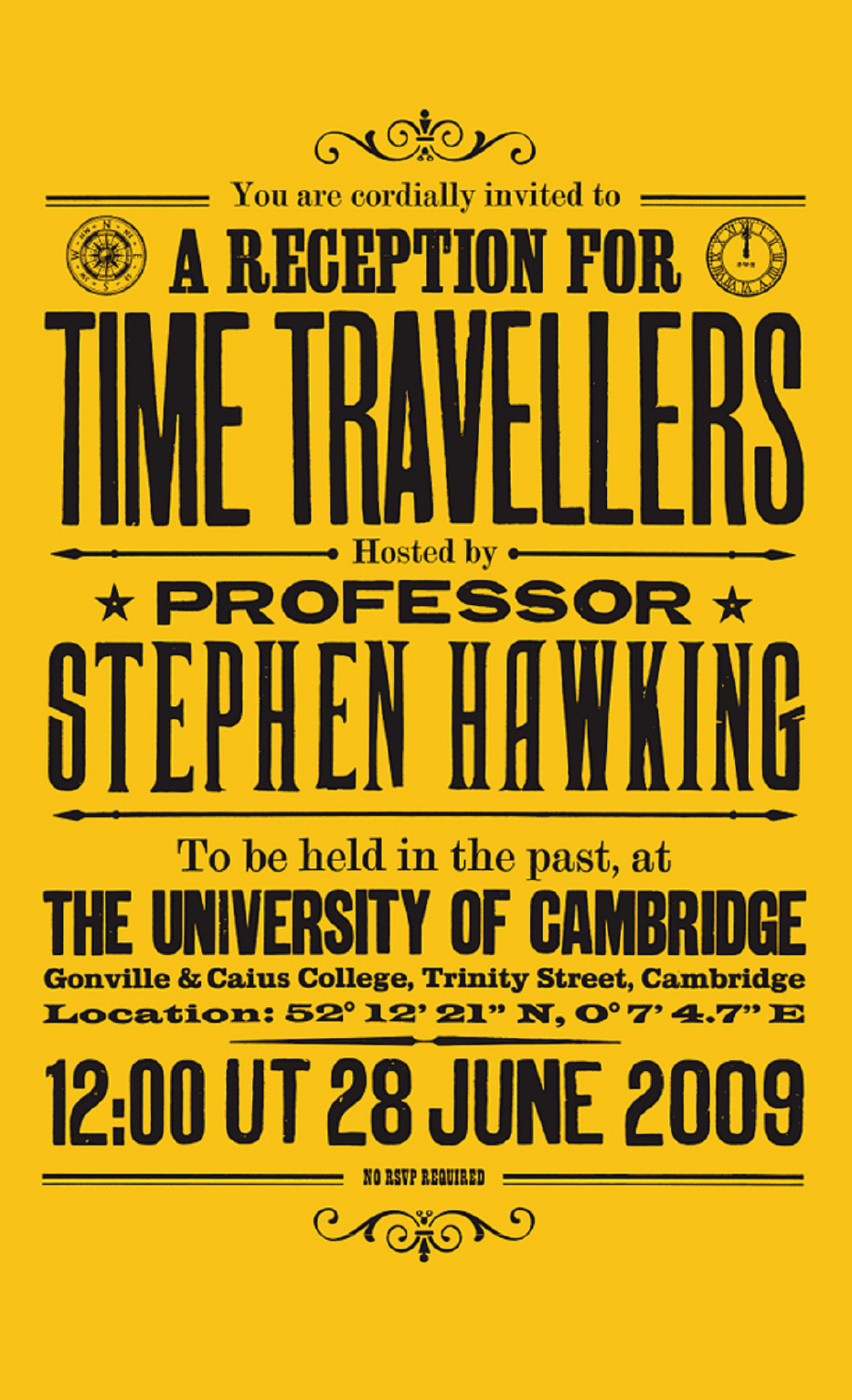
In 1990, with lifelong friend, the physicist Kip Thorne, Stephen approached the controversial notion of whether time travel is allowed by the laws of physics utilising the concept of wormholes, hypothetical tubes of space-time. Stephen concluded this serious analysis with the finding that although it may turn out that time travel is impossible, “… it is important that we understand why it is impossible.” As a later aside to this, nearly 20 years later Stephen planned a party for time travellers. He wrote invitations, set a date, time and venue and provided precise GPS coordinates. But he did not send out the invitations until after the party date was over. That way, only those who could genuinely travel back in time would know of it and be able to attend. On the due day Stephen sat politely and waited. But no-one came. And that was the point. “I have experimental evidence that time travel is not possible”, he said afterwards. And the champagne went back on ice.

In a sensational scientific U-turn in 2004, Stephen announced he had solved the black hole information paradox he had identified in 1974, stating that black holes do not destroy all that is sucked into them and that information can be retrieved. Conceding a bet with fellow scientists when he had previously argued to the contrary, Stephen and Kip Thorne awarded their American colleague, John Preskill, an encyclopaedia on baseball saying, that ‘(baseball) information can be retrieved at will’. At the time, Stephen confessed that saying information was lost in black holes was his biggest blunder. However, physicists continue to argue about whether information is lost in black holes or not. It is perhaps a tribute to Stephen’s genius that the discussion is still going on after almost half a century.
The marriage to Elaine broke down and the couple divorced in 2006. In April 2007, Stephen undertook a zero-gravity flight in a Boeing 727 jet in order to promote public interest in space travel and raise money for research into ALS. He had been invited by space pioneer and entrepreneur Peter Diamandis who founded the X Prize. A keen advocate of the need for space travel to find alternative planets for human habitation, Stephen remained in the air for two hours and underwent eight zero-gravity dives, allowing him to experience weightlessness and to be freed from the frustrating restrictions of his wheelchair. One of the most iconic of all the images of Stephen shows him floating, weightless, with an apple hovering above his shoulder and a huge smile on this face. He quipped afterwards, “Space, here I come. A zero-gravity flight is the first step towards space travel.” Stephen always hoped to make it into space himself one day. He was invited by Richard Branson to travel on Branson’s first space flight. Such was Stephen’s pioneering spirit, he accepted immediately. Sadly, Stephen never got the chance to fly in space.
Also in 2007, Stephen founded the Centre for Theoretical Cosmology, based in the Centre for Mathematical Sciences, University of Cambridge, and set up to, ‘advance the scientific understanding of our universe, taking forward the vision of its founder.’ More recently, the Centre launched the Stephen Hawking Programme, a campaign to celebrate and memorialise Stephen's life and work through a programme of teaching, research and outreach. The programme will perpetuate Stephen's legacy and will ensure the vitality and excellence of its ongoing research in cosmology and gravitation.
In 2009, Stephen was awarded the US Presidential Medal of Freedom by President Barack Obama, the highest civilian award in the United States. Received by very few scientists, it was given in recognition of his ‘persistence and dedication [which] has unlocked new pathways of discovery and inspired everyday citizens.’

In 2012, in a dazzling, star-lit ceremony, Stephen opened the Paralympics in London’s Docklands to a packed stadium. Entitled ‘Enlightenment’, Stephen compared the entire event with some 3,000 performers promising an ‘evening of exploration’, as he exhorted the 62,000 spectators to ‘look up at the stars’. As an addition to the fun-fest of the splendidly choreographed display by disabled athletes, Stephen’s appearance received loud applause when he said, “However difficult life may seem there is always something you can do and succeed at. Good luck to you all…”.
In 2013, Stephen won one of the two Breakthrough Prizes in Fundamental Physics for his discovery of Hawking radiation from black holes, and for ‘his deep contributions to quantum gravity and quantum aspects of the early universe’. This award was especially treasured by Stephen as it validated his lifelong discoveries without the need for experimental confirmation that, in this case, is very difficult to achieve. So difficult in fact, that this lack of experimental confirmation of Hawking radiation and other of his theories excluded Stephen from winning the Nobel prize for physics – the major disappointment in his academic life and career.
In 2014, Stephen revised his theory about the information paradox, even writing that, ‘there are no black holes’ – or at least in the way that cosmologists traditionally understand them. His theory removed the existence of an ‘event horizon’, the point where nothing can escape. Instead, he proposed that there would be an ‘apparent horizon’ that would alter according to quantum changes within the black hole. But the theory, too, remains controversial.
That same year saw the release of The Theory of Everything, the film of Stephen’s life which opened to great critical acclaim. Based on the personal memoir of Stephen’s wife, Jane, the film garnered major awards, resulting in an Oscar for actor, Eddie Redmayne, who perfectly captured not only Stephen’s declining health but his wit, determination, stubbornness and single-minded pursuit of scientific knowledge. Stephen was initially cautious about the film but once he met Redmayne and read the script, he changed his view and allowed the film to use his synthesised voice. Overall both Stephen and Jane were pleased with the film although Stephen would have liked it to contain more physics. Its success brought Stephen’s academic discoveries to a wider public and further underlined his innate humanity.
Stephen celebrated his 75th birthday in January 2017, an incredible achievement for someone who was told he had two years to live in 1962. Cambridge University marked this august occasion with an international conference entitled ‘Gravity and Black Holes’, held in July at the Centre for Mathematical Sciences. Twenty renowned scientists gave papers at the three-day conference. At the time, Stephen said, “It has been a glorious time to be alive and doing research into theoretical physics. Our picture of the Universe has changed a great deal in the last 50 years, and I’m happy if I’ve made a small contribution.” And he said he wanted others to feel the passion he has for understanding the universal laws that govern us all. “I want to share my excitement and enthusiasm about this quest. So, remember to look up at the stars and not down at your feet. Try to make sense of what you see and wonder about what makes the universe exist. Be curious, and however difficult life may seem, there is always something you can do, and succeed at. It matters that you don’t just give up.”
Also in 2017 Stephen co-authored a paper with Malcolm Perry (Cambridge) and Professor Andrew Strominger (Harvard) entitled ‘Soft Hair on Black Holes’, purporting to make progress towards an ultimate solution to the black hole information paradox. Refuting Stephen’s earlier argument claiming that information was irretrievably lost in black holes the paper identifies how information is not lost but is ‘contained’ within strands surrounding the black hole’s edge, the event horizon.
In November 2017, Stephen made what would become his last public appearance to a packed Union chamber when he gave the inaugural speech for the Cambridge Union Society’s announcement of its Professor Hawking Fellowship. The Fellowship is designed to celebrate STEM disciplines and acknowledges those individuals who, according to Lord Smith of Finsbury, chair of the Union’s trustees, ‘… have changed the world through the application of science and technology’. In 2019, the choice of Hawking Fellow was Bill Gates.
On 14th March 2018, Professor Stephen Hawking died peacefully at his home in Cambridge (in a strange tribute, this date is also the birthday of Albert Einstein). At the private funeral in Cambridge, the streets thronged with admirers and fans who saw Stephen as very much ‘one of their own’. His impressive but poignant memorial service held on 15th June 2018 in Westminster Abbey was a more formal affair with luminaries from academia around the world paying tribute to Stephen’s scientific legacy. However, at both ceremonies, there was much emphasis on Stephen’s humanity, his humour, his family (he was a devoted family man with three much-loved children and grandchildren) and his charitable work, mostly for the disabled community and education. His ashes are interred next to Sir Isaac Newton and Charles Darwin. The words on Stephen’s grave stone are a direct translation from the Latin of those on Isaac Newton’s grave – ‘Here lies what was mortal of…..’
There is a postscript. In October 2018, John Murray published Stephen’s posthumous popular book, Brief Answers to the Big Questions. This book was a project that Stephen had begun in his lifetime, to bring his writings for a general audience together into one definitive volume. While the manuscript remained unfinished at the time of Stephen’s death, his colleagues, family and friends collaborated in order to publish this collection of short essays on the questions that Stephen was so frequently asked during his lifetime. It felt important to those who had been close to Stephen for so many years that his theories, thoughts and ideas were published in order that he himself should define his legacy. Brief Answers to the Big Questions has been a best seller in 45 countries and sold 2.5 million copies since publication, showing that Stephen’s influence and brilliance remain undimmed, even though he is no longer with us.
Finally, two posthumous papers appeared. The first in April 2018 was written with Thomas Hertog. Stephen details his last theory on the origin of the Universe, based on the concept of eternal inflation which lays the ground for the existence of parallel universes. It argues there are many universes other than our own. The paper is entitled “A Smooth Exit From Inflation” and its latest revisions were made on 4th March, ten days before Stephen died.
When Stephen died, there was a paper in preparation with Sasha Haco, a graduate students, Malcolm Perry and Andrew Strominger. In this paper, an explanation of how black hole entropy arises at the microscopic level is proposed. If the ideas in this paper hold water, then it gives insight into the information paradox and how it might be resolved. As Stephen’s lifelong friend, the physicist Kip Thorne said at Stephen’s memorial service at Westminster Abbey ‘Stephen gave us big questions.” As more work is done on Stephen’s theories over the decades and centuries to come, we may find that Stephen gave us the answers as well. We just need to be smart enough to find them.
Research Fellow, Gonville and Caius Coll., 1965–69; Fellow for distinction in science, 1969–; Mem. Inst. of Theoretical Astronomy, Cambridge, 1968–72; Research Asst, Inst. of Astronomy, Cambridge, 1972–73; Cambridge University: Research Asst, Dept of Applied Maths and Theoretical Physics, 1973–75; Reader in Gravitational Physics, 1975–77, Professor, 1977–79. Fairchild Distinguished Schol., Calif Inst. of Technol., 1974–75. Reith Lectr, 2015. Mem., Pontical Acad. of Scis, 1986–; Foreign Mem., Amer. Acad. of Arts and Scis, 1984; Internat. Mem. (formerly Foreign Mem.), Amer. Philosophical Soc., 1985. Hon. Mem., RAS (Can), 1985. Hon. DSc: Oxon, 1978; Newcastle, Leeds, 1987; Cambridge, 1989; hon. degrees: Chicago, 1981; Leicester, New York, Notre Dame, Princeton, 1982; Tufts, Yale, 1989; Harvard, 1990. (Jtly) Eddington Medal, RAS, 1975; Pius XI Gold Medal, Pontical Acad. of Scis, 1975; Dannie Heinemann Prize for Math. Phys., Amer. Phys. Soc. and Amer. Inst. of Physics, 1976; William Hopkins Prize, Cambridge Philosoph. Soc., 1976; Maxwell Medal, Inst. of Physics, 1976; Hughes Medal, Royal Soc., 1976; Albert Einstein Award, 1978; Albert Einstein Medal, Albert Einstein Soc., Berne, 1979; Franklin Medal, Franklin Inst., USA, 1981; Gold Medal, RAS, 1985; Paul Dirac Medal and Prize, Inst. of Physics, 1987; (jtly) Wolf Foundn Prize for Physics, 1988; Britannica Award, 1989; Prince of Asturias Foundn Award, Spain, 1989; Julius Edgar Lilienfeld Prize, 1999; Klein Medal, Nobel Inst., 2003; Michelson Award, Case Western Univ., 2003; James Smithson Bicentennial Medal, Smithsonian Inst., Washington, 2005; Copley Medal, Royal Soc., 2006; Fonseca Prize, Univ. of Santiago de Compostela, Spain, 2008; US Presidential Medal of Freedom, 2009; Cosmos Award for outstanding public presentation of Science, Planetary Soc., 2010; Special Fundamental Physics Prize, Fundamental Physics Prize Foundn, 2012